The Promoting Life Together Collaborative Story: Our Ongoing Journey of Relationship and Partnership Strengthening
A collaborative is a learning network designed to support teams to realize improvements for the people they serve through relationship and partnership building. In 2017 the Promoting Life Together Collaborative was created to facilitate relationship development between health organizations and Indigenous communities to address suicide prevention and life promotion. We hope others can build on our experience and create their own processes of relationship and partnership strengthening that works for them and their partnerships.
[01:51]
[Albert Dumont]: My name is Albert Dumont. I'm an Algonquin, and right now I’m living in the Algonquin community of Kitigan Zibi. My connection to the PLT Collaborative and how they look at me as somebody that could bring in my definition of Indigenous knowledge, my spiritual beliefs, my life experiences to help out. And I'm grateful, because I'm committed to the health and well-being of our Indigenous communities. Ceremony has always been really important to me. I'm very grateful to the collaborative for always beginning their meetings and gatherings and everything that they do with a ceremony, with a prayer and with teachings. And it's always done in such a respectful manner. I've always actually have kind of felt special every time because I don't take these things for granted. To me, it's an acknowledgment that the Indigenous worldview matters and that somebody is interested in it.
The Promoting Life Together Collaborative
[03:18]
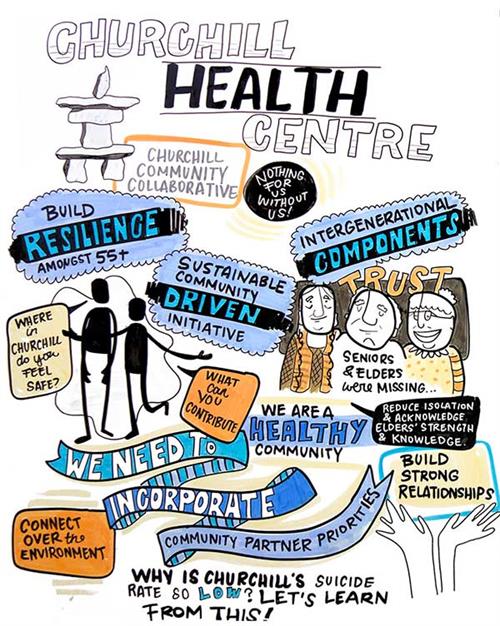
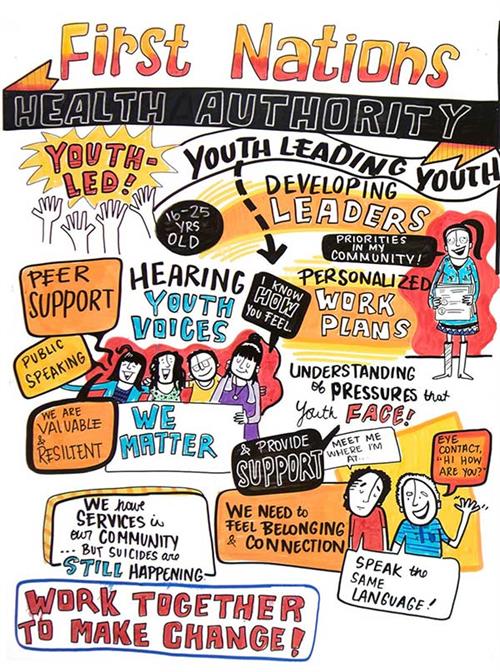
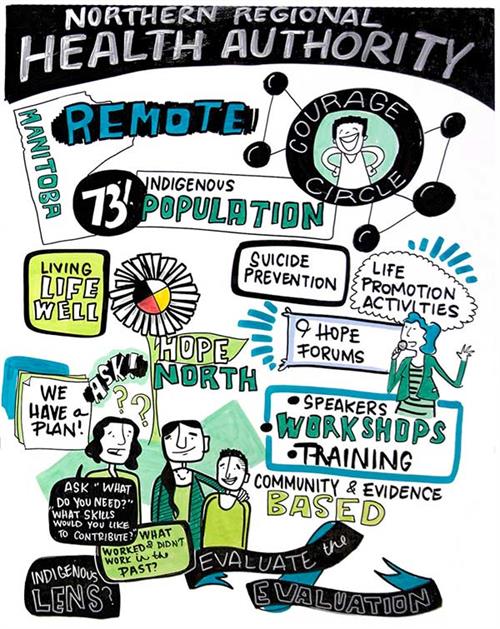
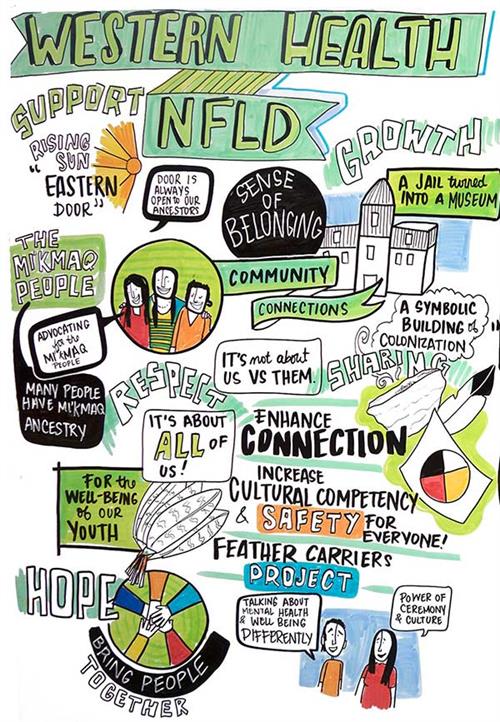
[Despina Papadopoulos]: The Promoting Life Together Collaborative brought together teams from coast to coast to support the development of meaningful partnerships between regional health organizations and Indigenous communities to develop life promotion initiatives. Six teams from across northern and remote regions in British Columbia, Alberta, Ontario, Newfoundland, and two teams in Manitoba participated in the collaborative. As the convener of this initiative, our organization became the seventh team, as it became very apparent that we were also learning alongside all of the teams. This 19-month initiative included coaching for each team by experienced knowledge keepers and service providers who mentored the teams to enhance their capacity for relationship and partnership building with Indigenous organizations and communities.
Building Relationships
[04:24]
[Despina Papadopoulos]: The Canadian Northern and Remote Health Network brings together northern health leaders to enhance leadership and to provide opportunities for shared learning and collaboration. In 2017, the network discussed their intention to focus on a suicide prevention life promotion collaborative in northern and remote regions of Canada, and they requested support from the Northern and Indigenous Health Team of the Canadian Foundation for Healthcare Improvement. Indigenous knowledge holders and organizations, including the Thunderbird Partnership Foundation and First Peoples Wellness Circle, were subsequently asked if they were open to having conversations to explore partnership and to codesign a collaborative.
[05:05]
[Carol Hopkins]: When we first started our relationship, we were very intrigued about CFHI and how they support their stakeholders through the collaboratives, and specifically in bringing on First Nations or Indigenous faculty or– to deliver training. And so that was one piece that interested the organization. Further to that, there was interest in working with CFHI to build relationships with provincial health authorities. And so we did that for a period of time. We were in conversation. We actually signed a memorandum of understanding with CFHI. But then there were some challenges in the relationship and really, those challenges were broader issues than just an individual. And we didn't quite understand them at first in the context of the organization. And as we continued the conversation over time, there was a little bit of a pause. And when I think about that now, it was a good pause because it was an opportunity for reflection. And as new people came on, Carol Fancott, and later on meeting Despina Papadopoulos, we had an opportunity to have further conversation about the relationship, about the partnership and how to grow that, and to understand the different factors or variables that were part of every relationship. So whether it's a relationship between organizations or a relationship between people, there are different factors and variables that are at play. And so the conversation really was about exploring those elements and trying to understand them. And one of the key things that I found critically important and in our work together to re-establish the relationship with greater clarity is the genuine listening skills. And so often times there would be conversations and then questions that maybe sometimes were asked with a little bit of shyness.
[07:48]
[Carol Fancott]: Yes, it was daunting. The subject matter is very difficult, and feeling– we want to make a difference in this area. And it matters. And it matters to our partners, our northern network partners. But it also matters to all of us within CFHI and to the Indigenous partners that we were forming new relationships with. So, yeah, it was– and sometimes I think maybe it was the newness that was actually quite helpful. I was new to CFHI, I was new to this area, and I was very open to wanting to learn. And I didn't have any preconceived ideas about how we run collaboratives, how we run programming. It was truly, and I think our entire team, the Northern and Indigenous Health Team, was very open because this was the first collaborative that we were doing as a group in this area. And so, again, going in without preconceived ways that we had to work, I think there was an element of freedom in that.
[08:58]
[Carol Hopkins]: And so that's the second piece of this key learning for me, and re-entering a relationship and working on it, is not letting fear hold you back and making sure that when you are in a difficult place of understanding, that you simply say that. “This is the way we've always done business. And we've heard that that doesn't sit well. It doesn't accommodate, it doesn't respect, it doesn't reflect the values or the needs that you have expressed on behalf of First Nations people. Let's talk about that.” And so that's another important element, following, you know, the courage to have the dialogue, to have the hard conversation, to be respectful in the questions, is to take time. And my father used to say to me, anything worth having takes hard work. It takes time. And so we spent time in conversation and asking the question, exploring the possibilities, learning about where we've been and where we can go. Who else needs to become part of the relationship? Is it ready to invite others, are we ready to invite others to the relationship, to the conversation, for the potential and possibilities for the future? It wasn't a conversation or a relationship that was nicely mapped out as a logic model. We're going to go from step A to B to C, and the outcome we're hoping for is this. We explored it and we were willing to map it out as we went along.
Sharing Experiences in Our Relationships
[10:57]
[Despina Papadopoulos]: Relationship development was an ongoing process that pervaded all aspects of the work. We focus on building and nurturing trust-based relationships, and sometimes it was hard work, but often our relational experiences were inspiring, and we became part of something greater than ourselves.
[Dr. Ed Connors]: I recall vividly one of the first experiences we had when we went to Western Health, Newfoundland, how we one morning as we began, at the beginning, the first thing we did the morning of the first gathering with that group was we gathered on the shore of the ocean and we conducted what we call a sunrise ceremony. And the people who participated in that sunrise ceremony were the people from CFHI, ourselves, and the community members who were participating, as well as the people who came from the Western Health organization. And that morning when we conducted that ceremony, I think you could, you know, speak to any one of those people, and they could tell you vividly their recollection of how when we lit the fire on the shore and we began the ceremony, how the sun came up, and as it was rising it hit the face of a cliff, and that cliff just turned golden. And as that happened, we heard– some people who were facing out to the ocean actually saw two seals pop their heads up and sit there and watch and listen as we were participating in that ceremony. Those kinds of experiences were what in fact built those relationships in the way that I have just shared with you, that our ancestors imagined could happen.
Guidance Group
[13:08]
[Despina Papadopoulos]: The guidance group of the collaborative included a spiritual advisor, First Nations and Métis mental health leaders, a youth representative, an external evaluator, as well as representatives from national mental health organizations. This group supported the creation of guiding principles for the work of the collaborative, which focused on cultural humility, respect for Indigenous knowledge and diverse Indigenous voices and an understanding of strength-based approaches to Indigenous health.
[13:39]
[Brenda Restoule]: The conversation we had around the guidance group, I think, was really born out of the recognition of a collaborative that would have equity, I think, in the ability to co-lead and to codesign the work that we were doing. And so when we first started on this journey with CFHI, and Thunderbird was brought into the conversation along with First Peoples, there was a recognition that having the opportunity to bring in multiple voices that could contribute to the conversation around mental wellness and Indigenous mental wellness was critical. We, as First Nations people, couldn't speak on behalf of the other Indigenous groups, but it was important to have people at the table who had Métis knowledge and who were familiar with the concepts of mental wellness and had worked with communities around Métis wellness and Métis health indicators, I guess you could say. So there was an important part, I think, about that. It wasn't just one way of doing and one way of knowing that helped to guide the work that we were doing as a guidance group. And so there was that opportunity for co-learning and codesigning that came by creating a guidance group that had both Indigenous and non-Indigenous organizations at the table with the knowledge around mental wellness and suicide prevention and, ultimately, life promotion. Because of the recognition in the guiding principles around reconciliation and health transformation, that for so long there had not been equitable opportunities for Indigenous knowledge to play an equal part in the development of new initiatives or new knowledge that influences health care and health systems.
[16:20]
[William (Bill) Mussell]: I really enjoyed being co-chair with Carol of CFHI, and again, doing everything that we could to honour the implementation of the guiding principles, and in particular, paying particular attention to knowledge translation both ways, in terms of the English speakers, in terms of what it is they're talking about to help make sure that we understand as the Indigenous participants and vice-versa, that they understand our Indigenous points of view, and appreciating at all times that the project we were working on had to build on strengths of the Indigenous community and how important it was that we build on those strengths in regard to the knowledge that we rely upon, and making the decisions and choosing the directions we go. And, as was described, creating the kinds of living circumstances where each of us feels safe enough and comfortable enough with each other relationally to be able to be open and honest about our thoughts and feelings and particularly comfortable about talking about our inner life, as opposed to playing it safe at all times and waiting for the circumstances to say something that really had little to do with our inner world. Because I'm a real believer that we really were challenged as human beings to bring together things of our external world with our inner world. And when we're able to do that, we're able to make the kind of meaning necessary that's going to help us to navigate life quite successfully, along with many other people, because of the importance of community in our life on Mother Earth and the importance of all working together, much like it is modelled through Mother Earth for us to be able to ensure that we're attending to the needs of people of seven generations and more into the future.
Indigenous Knowledge
[18:41]
[Carol Hopkins]: One key piece that was so critical in a relationship, in a memorandum of understanding, which was about the ownership of knowledge, and how do you engage in a relationship that doesn't damage or take away or diminish ownership of knowledge? I often talk about Indigenous knowledge and the difference between Indigenous knowledge and sacred knowledge. Sacred knowledge belongs to the cultural societies, the medicine societies, ceremonial societies of First Nations people across Canada. And there are many distinct and unique societies that hold that sacred knowledge that has gone across many, many generations fully intact. And there are certain parameters around that knowledge, and it's specifically for First Nations people. But as holders of that knowledge, students of that knowledge, teachers of that knowledge, we all have the responsibility and learn how to translate that knowledge. Likewise, communities, they have their stories about how to live life well, and that knowledge is the same. It's been passed on from generation to generation with the mindset of supporting the future with good guidance for living life well. That's sacred knowledge. All of that gets translated across generations because it has to apply in the current context. And so the discussion on the ownership of knowledge was so critical because from a First Nations lens, it doesn't belong to any organization. It belongs to the people. It belongs to our future, and we have a responsibility to ensure its integrity and its safety for the future. That was the critical conversation that we were having with CFHI. And they had the courage to have the conversation.
A Paradigm Shift to Life Promotion
[21:08]
[Despina Papadopoulos]: We learned that a strength-based approach to mental wellness requires leading with language of life rather than relying on deficit-centred risk factor language. This understanding led to a paradigm shift from suicide prevention to life promotion.
[Ed Connors]: What we really needed to be doing if we were really going to help people to live long and good lives was to focus on life and not to focus on death or trying to prevent death. That in actual fact, we could not prevent death, but we can help people and support people to live longer and healthier lives.
[Brenda Restoule]: Part of what led to the whole discussion around changing the context of the work from suicide prevention to life promotion, because it allowed us to then change the narrative around the language we use from suicide prevention to life promotion. And it allowed us to think about this work from a strengths-based perspective as opposed to deficits and illness. And I think in doing so, it also allowed us to be centred around spirit. And I think that when we're talking about life promotion, it really needs to be centred around spirit.
Ceremony
[22:35]
[Despina Papadopoulos]: Albert Dumont was offered tobacco with the request to accept the role of spiritual advisor to the guidance group, and he accepted. His guidance cultivated strength in unity and ensured that ceremony was honoured and integrated into all of our meetings.
[Brenda Restoule]: From an Indigenous perspective or a First Nations perspective, we always are guided and supported by an Elder. And so the group was quite supportive of the notion of making sure that there was an Elder that led our group and ensured that we did things in a good way, that it was led by spirit, it was led by ceremony, and it continued to, in some ways, place a little bit of extra value on Indigenous knowledge, not because we thought it was better than, but because of the recognition in the guiding principles around reconciliation and health transformation that for so long there had not been equitable opportunities for Indigenous knowledge to play an equal part in the development of new initiatives or new knowledge that influences health care and health systems. And so by placing an Elder in that role, it ensured that there was a little bit of extra weight given to Indigenous knowledge, so we could give it some equity that it had not previously had.
[Kelly Brownbill]: It's sometimes difficult for non-Indigenous people to enter into a circle, to enter into the ceremonies, particularly since a lot of the non-Indigenous people that were part of this process maybe didn't have a faith community of their own. Maybe they weren't used to ceremony or ritual within their lives. One of the things I tried to do in my part when I was bringing ceremony into our work was to talk about the fact that no one has to be confined by anyone else's idea of faith or spirit or ceremony, that you can come to a place in safety and participate in ways that are meaningful to you.
Coaches/ Mentors
[Despina Papadopoulos]: Building readiness and health organizations to effectively partner with Indigenous organizations was a key goal of this collaborative. The coaches visited the teams for in-person mentoring and followed up with regular teleconferences, and these experiential learning strategies were supported by topic-specific webinars.
[25:38]
[Denise McCuaig]: I joined the Promoting Life Together Collaborative as a coach two years ago. And when I was first contacted, it was described to me that I would be a coach for one or two teams somewhere in northern Canada that were looking at doing a suicide prevention project with youth, and that they were partnering with non-Indigenous partners, mostly health authorities, and that I would be available by phone to coach and mentor for about an hour every two weeks. That was the original description that I received, but it very quickly became much more than that. Where I think it worked really well from a coaching perspective is that we as coaches were able to meet with non-Indigenous staff, often from health authorities, and they could practice with us doing a land acknowledgement. Or they could ask questions about how to offer an Elder in the community tobacco, or about what was expected of them when they arrived in the community to dialogue with the Indigenous people who lived there. And I hadn't seen that model happen before, where non-Indigenous health care providers could have the opportunity to get coaching and mentoring, to practice these new ways of communicating and these new ways of engaging with their Indigenous partners. So I think it worked really beautifully, and it allowed them to build their capacity and to grow. And so I think as a coach, I also took the time to often challenge them to think about their unconscious bias, to think about their perception of First Nations and Métis and Inuit people based on where they learned their information, and to break down some of those barriers that existed, because a lot of information received as Canadians is coming from the media, and it's often slanted or skewed in one way or another. And so this was a chance for them to actually have discussion with us as coaches about what our true lived experience was, and how we felt history would potentially impact the ongoing communications or the goals that they were trying to reach.
[28:24]
[Brenda Restoule]: The guidance group spent quite a bit of time talking about what would be some of those key pieces of information or transmission of knowledge that could support them in their own collaborative, but also really create a shift in how the non-Indigenous health organizations and the Indigenous communities could work in a different way that would promote health transformation at the same time. And so some of the ones that they talked about, that they were offered, I should say, was allyship, cultural safety and humility, readiness, Indigenous knowledge, so centring Indigenous knowledge. And we had lots of discussions about who within the guidance group or outside of the guidance group might hold that knowledge, who could do those webinars. So they were created specifically for the collaborative. This wasn't knowledge that we, you know, went and picked off from somewhere else, but made it very specific to the conversations and the work that we were doing.
[29:42]
[Nancy Parker]: The fact that this was a learning collaborative was really key, and CFHI, just can’t compliment them enough because they supported constantly a very strength-based approach and acknowledged that every team’s journey is unique and of equal value. And, you know, again, in a Western perspective, we would maybe otherwise judge a team to say, oh, they got to these targets and other teams didn't, so therefore, they were better. But that, in fact, wasn't the case. We realized that a team maybe that had a whole different rhythm to their moving forward in their learning and understanding was perhaps maybe really, really, deeply transformational for them. And so I certainly saw on the team individual transformation of people's worldviews starting to shift. And I think, as others have mentioned, at times, it did mean some really kind but gentle pushing and questioning against bias or ways of doing, because there was that natural impulse to just go back to doing business as usual in thinking about moving a project forward. But that notion that you need to step back, you need to listen, you need to walk alongside, it doesn't mean your view isn't important. But in this particular process, in this particular collaborative, we are going to keep emphasizing the Indigenous voice and the Indigenous worldview. And so within that common ethical space that we've shared between these two worldviews, it was weighted more towards that voice. And I think that was essential in order to start some of that decolonization work with our Northern Health Authority team.
Evaluation
[31:44]
[Despina Papadopoulos]: A decolonizing approach was also applied to the evaluation of the collaborative. The Canadian Foundation for Healthcare Improvement supported innovation in the evaluation to ensure consistency with the guiding principles, Indigenous ways of knowing, Indigenous research methods, and Indigenous mental wellness frameworks. Most importantly, the evaluation framework recognized that our process, and particularly the quality of our relationships, were the main indicators of success.
[Marion Maar]: Mainstream evaluation frameworks are usually designed for urban programs. They often don't fit northern, rural, or Indigenous services very well at all. And when you are actually dealing with diverse cultures, diverse worldviews and program philosophies, then the assumptions on which the original evaluation framework was built on is simply inappropriate. And if you use it, you will– it will lead you to false conclusions.
[Nancy Parker]: It is all about Indigenous voice. It is all about the primacy of Indigenous voice and that Indigenous knowledge is evidence. We don't need to go through, you know, the Western ways of determining what's effective or not.
[33:02]
[Marion Maar]: The NIH team had to do some advocacy work for us internally to enable us to develop our own evaluation framework that would fit the collaborative, that would fit the principles, and that allowed us then to apply a participatory framework. What our approach was to seek to understand processes, the how, why, and under what circumstances, for example, good relationships could be developed between mainstream and Indigenous organizations. We relied a lot on qualitative methods and Indigenous research methods, and I believe, as an external evaluator, that this really allowed us to come up with an evaluation and a report that was strong. It was rigorous, valid and accountable. It measured what we set out to do. So it looked at, you know, under what circumstances relationships could be built. It allowed us to track innovations that happened, for example, changes in the coaching model. Because part way through, we realized the coaching model had to be adapted. There had to be more experiential learning, so all those things could be accounted for with our evaluation framework. Another thing that was important is also to include Indigenous research methods. So as part of this, our evaluation became a quest for truth and healing, because as we were sharing our learning in an ethical space, we could also address and resolve issues at the same time.
[34:48]
[Carol Fancott]: And that was a real key learning for us to let go of some of those traditional indicators that we would always look at as part of our collaboratives, and to be able to open ourselves up much more to be thinking about, sort of, the importance of relationship in this work. And that was a very valid outcome that we needed to understand. And that the only way we would understand it was actually through a process evaluation.
Sustainability
[Kelly Brownbill]: There's 500 years of creating paradigms and policies and procedures that minimized Indigenous voices, so we need to make sure that we have the ability to support the sustainability moving forward. Part of the process in the collaborative was asking them, okay, we're going to leave eventually. The coaches are going to withdraw, the support of the funding agency is going to withdraw. What can we do right now to help you build a process that will keep this momentum going? Incorporating that Indigenous way of being is challenging, there's no roadmap, and it takes a significant investment in time, which is why it hasn't been done before. Sustainability, one of the other challenges, is how do we keep the momentum going? Incredible amounts of work were done on all sides of these collaboratives, particularly those mainstream agencies that said, “We're ready to make a change.” They put their heart and soul into hearing what they've been doing wrong, what they could do better. They invested so much humility in saying, “We might be experts in doing this work, but we certainly aren't experts on doing that work with Indigenous communities.” And I often use the expression, we're pushing a boulder up a hill, right? And every inch that boulder gets higher up the hill is a success. It's a celebration. It's amazing.
[36:56]
[William (Bill0 Mussell]: If we experience the benefits of teaching and learning through the building of relationships and the sharing of stories and lived life experiences, and create a need to know on the part of those we're interacting with, because by interacting in that way, we're really demonstrating a need to know, if we can inspire that kind of activity, and people experience the payoffs and the benefits from enhancing their knowledge and understanding and enhancing their ability to form relationships with other people and other things and Mother Nature and so on, they're going to be able to embrace life more fully, and by embracing life, then take care of sustainability.
Health Transformation: The Way Forward
[Despina Papadopoulos]: Health transformation is a process, not an outcome, and it takes time. Truth and reconciliation is an ongoing journey, and it begins with creating readiness within mainstream health organizations to develop respectful relationships and partnerships with First Nations, Inuit and Métis organizations and communities.
[38:25]
[Mariette Sutherland]: I wanted to share a little bit about the seventh guiding principle, which is really about system change, and again, link it back to the idea of the learning journey and the process undertaken in the PLT Collaborative. Really, the guidance group was thinking long and hard about, you know, how does change happen. And I spoke earlier a little bit about change management process, and you know, there's certainly a lot of, you know, mainstream models and approaches to that. I think, though, the PLT Collaborative was able to look at change management in a much more relational and spirit-centred way. And I think that will have way more traction in the long run, because often, I think change management processes happen to be couched or framed in very tactical and strategic ways. And missing from that is that notion of the spirit and intent behind it, you know, how people are feeling. So when you understand that change management is not an organization with disparate parts and, you know, units of service or departments or programs, but it's actually people, when you understand that change is driven by people, then coming at it from a relational and spirit-centred approach absolutely makes sense. And I think for Indigenous people just generally, we've always known that before any change happens, you establish a relationship and acknowledge one another’s spirit and understand where they're coming from.
[40:21]
[Ed Connors]: We've been part of this journey, all of us, and we are all needing again to come back to this place of good relationship. And I believe that this is part of what’s happened in this collaborative. It's an important part of the process of reconciliation, and what we would refer to as healing, and what we also speak of, when we, in our work, in the Anishinaabe language, they refer to it as bizaani-bimaadiziwin, living the good life or living a long and good life.
[Kelly Brownbill]: I've often mentioned that CFHI is the first contract I ever signed that had the protection of Indigenous knowledge embedded in my contract. No one had ever done that before. Those are the things that we need to do, whether it's with the PLT Collaborative, whether we're working with a mainstream corporate organization, or whether we're working with a government agency, we need to continue to listen to Indigenous ways of being and knowing, we need to continue to look for ways to incorporate that within the bigger picture. We need to continue to find ways to support people who have been entrenched within government policy and corporate procedures, to support them to really want to change or to consider change. It's very vulnerable for them. So it's so important that we continue to look for ways that we can support them to want to go into this work, because that's when the collaborative is the pebble in the pond, right, and the ripples spread out farther and farther and farther.
[42:10]
[Albert Dumont]: We need to be dedicated. And for the sake of the next generations, we need to understand about what it is just to hold your grandchild, hold them in your arms, and imagine that you're holding that grandchild's grandchild or your grandchild's grandchild’s grandchild. Because it's the same thing, it's your relative, it’s your blood relative. But you're able to hold this grandchild physically, the next one, you're going to be holding them spiritually, and if I have my way, there's going to be help for them too, yeah. So it's good to talk about it and have the opportunity to talk about it, because that's what the collaborative is supposed to be all about, and I believe it is. That they’re trying, we’re all trying our hardest to do some good work together as one, as a unit, as a team. And that's finding the strength to keep pushing forward.
Kelly Brownbill sings the “Water Song.”
"Water, we love you. We thank you. We respect you."
The Water Song used by permission of Dorene Day, Waubanewquay, Wazbizheshi Dodem.
The Canadian Foundation for Healthcare Improvement (CFHI) and the Canadian Patient Safety Institute (CPSI) are now amalgamated as a new organization, Healthcare Excellence Canada (HEC). Healthcare Excellence Canada is an independent, not-for-profit charity funded primarily by Health Canada. The views expressed herein do not necessarily represent the views of Health Canada.
:quality(80))
:quality(80))
:quality(80))
:quality(80))